The Rich History Behind Traditional Jamaican Food

Jamaican food carries the weight of centuries. It tastes of migration, survival, celebration, improvisation, and fierce local pride. A plate of ackee and saltfish or a foil bundle of jerk pork is never just a meal. It is evidence of who came to the island, who was forced there, what grew well in the soil, what could be preserved on long voyages, and what people created when they had to make something nourishing out of very little.
That is one reason Jamaican food leaves such a strong impression on visitors. The flavors are bold, but the appeal goes deeper than heat or sweetness or smoke. Traditional dishes hold stories in plain sight. The cod in saltfish points to transatlantic trade. The yam and callaloo speak to African agricultural memory. Curry goat reveals Indian influence, but it does not taste like a copy of Indian curry. It tastes Jamaican, because the island has a way of absorbing outside influences and giving them a distinct local life.
To understand traditional Jamaican food properly, it helps to stop thinking of it as a single fixed cuisine. It is more accurate to see it as a layered food culture shaped by Indigenous knowledge, colonial power, African resilience, Asian migration, tropical ecology, and generations of home cooks who understood seasoning better than any written recipe ever could.
Before the plantations, there were the Taíno
Long before Jamaica became known for sugar, rum, and export crops, the island was home to the Taíno, an Arawakan people whose foodways established some of the earliest foundations of local eating. Their influence is often overshadowed in casual discussions of Jamaican food, but it remains important.
The Taíno cultivated cassava, maize, sweet potato, peppers, and various fruits. Cassava in particular mattered because it could be processed into bread https://israelvzzi846.juniperbrief.com/posts/delicious-jamaican-food-ideas-for-your-next-family-dinner and stored, a practical answer to tropical conditions. They also drew heavily from the sea and from rivers, using methods suited to an island environment where fishing was central to daily life. Barbecuing, the slow smoking of meat over a wooden frame, is one of the techniques linked to Indigenous Caribbean practice, and the very word “barbecue” traces back through the region’s early languages.
Even where the exact dishes did not survive unchanged, the basic logic did. Jamaican cooking still relies on root crops, peppers, and practical preservation methods. It still treats the sea as a pantry. It still prizes foods that can feed households steadily rather than impress for a single night.
The Spanish and British years changed the island’s table
Spanish control began in the late fifteenth century, followed by British conquest in 1655. Colonial rule transformed Jamaica’s food system on a scale that is hard to overstate. Land was reorganized for empire. Sugar plantations expanded. Livestock, imported crops, and new trade relationships altered what people could access and who controlled it.
The colonial kitchen was divided by class and race. Planters and colonial officials ate imported goods, refined baked items, salted meats, wines, and dishes meant to signal status. Enslaved Africans, who made the plantation economy possible, were often left with restricted rations and had to build their own food traditions under brutal conditions. Out of that inequality came one of the defining truths of Jamaican food history: many of the island’s most important dishes were not born from abundance. They were born from adaptation and skill.
Salted cod, now central to the national dish, arrived through trade networks tied to empire. It was cheap, durable, and could survive transport. What began as a practical preserved protein became something more interesting in Jamaican hands. Mixed with ackee, onion, thyme, scallion, and Scotch bonnet, saltfish stopped being a colonial ration and became part of a beloved breakfast.
That pattern appears again and again. Ingredients imposed by trade or scarcity were reworked through local taste. Jamaican cooks seasoned aggressively, paired cleverly, and made hard ingredients feel generous.
African knowledge sits at the heart of the cuisine
If there is one influence that most powerfully shaped traditional Jamaican food, it is Africa. Enslaved people brought not only labor but memory, cultivation practices, seasoning habits, cooking instincts, and ways of combining staples that still define the cuisine.
This is visible in the ingredients themselves. Okra, callaloo, pigeon peas, plantains, yams, and methods of one-pot cooking all connect in various ways to African food traditions and the broader Atlantic world created by forced migration. So does the habit of building flavor from fresh herbs, alliums, hot peppers, and slow simmering rather than relying on expensive imported luxuries.
Provision grounds, small plots where enslaved people sometimes grew food for themselves, played a major role in survival. These plots produced staples that fed families and local markets. Over time, they also protected culinary continuity. A person might have little legal freedom, but in a small patch of earth and in a cooking pot, cultural memory could still be practiced.
Runaway communities, especially the Maroons, preserved African-derived foodways in even more direct ways. The Maroons, descendants of Africans who escaped slavery and established autonomous settlements in Jamaica’s interior, are inseparable from the history of jerk. Their methods of seasoning and slow cooking meat over pimento wood in the hills were both practical and tactical. Smoke could be controlled, meat could be preserved, and flavor could be built deeply. Today jerk is one of the most recognizable forms of Jamaican food worldwide, but its roots are in resistance, not tourism.
Jerk is history you can smell
People often reduce jerk to a spice blend, usually one sold in a jar. That misses the point. Jerk is a method, a landscape, and a lineage.
Traditional jerk developed through a combination of Taíno smoking techniques and African, especially Maroon, meat preparation practices. The seasoning profile usually includes allspice, known locally as pimento, Scotch bonnet pepper, thyme, scallion, garlic, ginger, and salt. In some households and cookshops, cinnamon, nutmeg, or brown sugar appear as well. The exact formula varies, and arguments about the “right” version can become serious very quickly.
What matters historically is that jerk reflects the island’s ecology. Pimento wood contributes a sweet, aromatic smoke that is difficult to imitate elsewhere. Scotch bonnet brings more than heat. It adds fruitiness and a particular sharpness that lingers differently from many other chilies. Meat is often cooked low and slow, traditionally in pits or over improvised drums, allowing smoke, spice, and time to do the work.
A well-made jerk pork should not taste merely hot. It should taste layered, with pepper up front, spice in the middle, smoke throughout, and a savory depth that reaches the bone. Anyone who has eaten jerk from a roadside pan in Boston Bay or from a trusted neighborhood vendor knows the difference immediately. The scent travels before the food is visible. That aroma is one of the most persuasive culinary advertisements on earth.
Ackee and saltfish tells a wider story than most national dishes
Jamaica’s national dish captures the contradictions and creativity of the island’s history better than almost anything else on the table. Ackee is native to West Africa. It reached Jamaica during the colonial era and adapted beautifully to the climate. Saltfish, usually salted cod, came by way of European trade. Put together with tomato, onion, thyme, black pepper, and Scotch bonnet, they form something entirely Jamaican.
Ackee itself deserves respect. When ripe and properly prepared, it has a soft, buttery texture that surprises first-time eaters. It looks a bit like scrambled egg to the uninitiated, but its flavor is more delicate, slightly nutty, and perfect for carrying salt and spice. It is also a fruit that requires care, because unripe ackee is dangerous. The fruit must open naturally before the edible flesh can be safely used. That detail matters historically because it shows how local knowledge develops. Ingredients become traditional not just because they are available, but because people learn exactly how to handle them.
Ackee and saltfish is also a reminder that national identity can be built from fragments that did not originate side by side. Jamaica made them belong together. That act, repeated across many dishes, is part of the island’s culinary genius.
The plantation economy shaped both scarcity and celebration
Sugar dominated colonial Jamaica for generations, and sugar shaped eating far beyond the plantation fields. It transformed land use, labor patterns, and trade. It also created a world in which ordinary people often had to make meals from what remained after export priorities were satisfied.
This helps explain the importance of starchy staples. Green banana, yam, dumpling, coco, cassava, breadfruit, and sweet potato are not side notes in Jamaican food. They are the ballast. They fill the plate, absorb gravies, and provide staying power. A breakfast of saltfish, boiled green banana, dumpling, and yam was not designed for delicacy. It was built for labor, satiety, and value.
At the same time, the island’s festive foods developed extraordinary richness. Rice and peas, usually made with coconut milk and kidney beans or gungo peas depending on the season and the household, became a standard partner for Sunday dinner and holiday meals. Fried chicken, stewed oxtail, curried goat, and escovitch fish often appear when family gathers. Scarcity taught discipline, but celebration encouraged generosity.
One of the most striking things about Jamaican cooking is this balance between thrift and abundance. The same cuisine that honors provisions and preserved fish also produces black cake soaked in rum, deeply spiced sorrel drinks at Christmas, and lavish Sunday spreads that can feed far more people than seem to fit in the room.
Migration from India, China, and the Middle East broadened the pantry
After emancipation in the nineteenth century, Jamaica saw the arrival of indentured workers from India, as well as migrants from China, the Middle East, and elsewhere. Their influence on the island’s cuisine was profound.
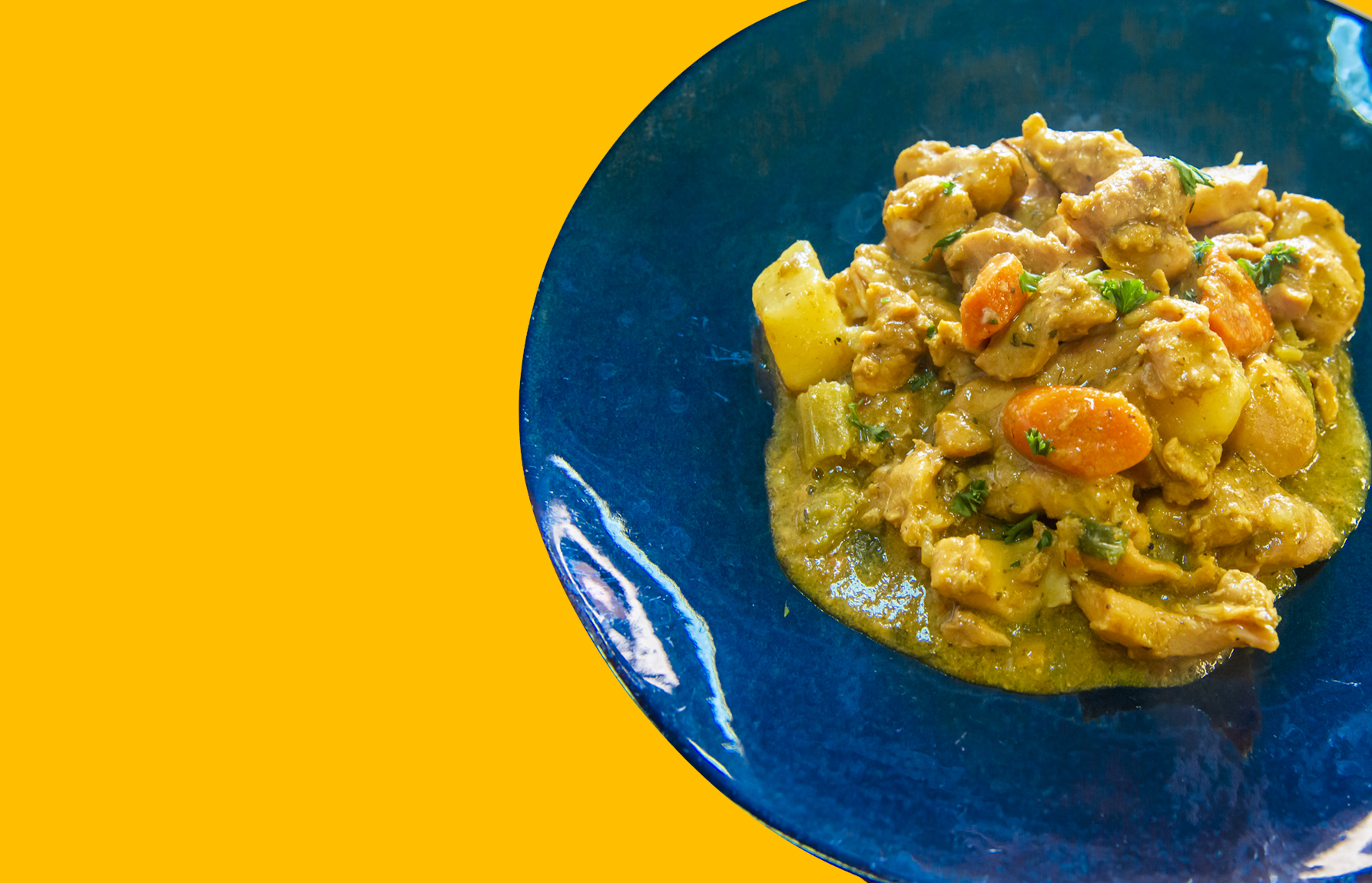
Indian migration helped establish curry as a major part of Jamaican cooking. Jamaican curry goat is the clearest example, but curry chicken, curry shrimp, and curry vegetables are also common. Yet Jamaican curry does not mirror Indian regional cuisines exactly. Local curry powders often emphasize turmeric, coriander, fenugreek, cumin, and allspice differently, and Jamaican cooks build the dish with their own logic. The meat is usually “burned” in curry first, meaning the curry powder is briefly fried in oil to deepen its flavor before liquid is added. The result is robust, earthy, and unmistakably local.
Chinese migrants contributed to shop culture and to everyday cooking in less flashy but lasting ways. Soy sauce, stir-fry methods, and sweet-savory combinations entered the local repertoire. Over time, these blended with island seasoning habits. The kind of Chinese Jamaican cooking found in households and takeout shops is its own category, not merely an imported cuisine dropped unchanged into the Caribbean.
Syrian and Lebanese merchants also became part of Jamaica’s commercial life, influencing food retail and urban eating patterns. These influences can be subtle, but they matter. Food history is not only about iconic dishes. It is also about who sold ingredients, who operated shops, what goods became affordable, and how urban communities ate on ordinary weekdays.
Soups, porridges, and the logic of nourishment
Visitors often focus on headline dishes, but the deeper emotional core of Jamaican food may lie in soups and porridges. These are the foods of recovery, routine, and care. They are what people make when someone is tired, under the weather, coming home late, or needing something that stretches.
Mannish water, red peas soup, chicken foot soup, fish tea, and pumpkin soup all speak to a cuisine that values extraction of flavor and nutrition from every available ingredient. Red peas soup, for instance, can combine kidney beans, salted beef or pig’s tail, dumplings known as spinners, coconut milk, herbs, and root vegetables into a meal that is far greater than the sum of its parts. It is filling, balanced, and economical.
Porridge has similar significance. Cornmeal porridge, peanut porridge, plantain porridge, or oats prepared with nutmeg, cinnamon, condensed milk, and a pinch of salt represent comfort with backbone. Jamaican breakfasts are often substantial, and porridge is part of that tradition. It bridges childhood memory and adult practicality.
These dishes rarely dominate international marketing campaigns, but they reveal how Jamaican food works at home. A cuisine cannot live on festival and jerk alone. It survives because everyday meals are sensible, flavorful, and adaptable.
The role of markets, yards, and roadside cooking
No real history of Jamaican food can ignore where the cooking happens. Markets, family yards, roadside stands, beachside grills, corner shops, and community events all shape the cuisine as much as formal restaurants do.
A market in Jamaica teaches you quickly that seasonality matters, even in a tropical setting where outsiders often imagine endless uniform abundance. Mangoes arrive in waves, each variety with loyal defenders. Gungo peas are tied to particular times of year. Breadfruit has its seasons. Fresh thyme, scallion, callaloo, cho cho, and Scotch bonnet define the visual grammar of the produce stalls.
Family yards matter just as much. For generations, cooking has been communal, practical, and public within the household. Someone washes callaloo, someone peels yam, someone tends the pot, someone checks the fire. Recipes are often transmitted by sight and feel rather than measurement. “Enough thyme” and “a likkle more pepper” are not evasions. They are part of an embodied culinary education.
Roadside cooking, meanwhile, has preserved some of the island’s strongest flavors. Pan chicken, roast yam, roasted breadfruit, soup on a Saturday, and jerk at night all live in spaces where speed meets tradition. A good roadside cook knows how to serve quickly without flattening flavor. That is not a small skill.
What traditional Jamaican food gets right about balance
One misconception about Jamaican food is that it is all heavy, fiery, and rich. Some dishes are, certainly. But traditional cooking often shows better balance than people expect. Heat is present, yet not always dominant. Acidity appears through escovitch pickling, lime, tamarind, and fresh tomato. Bitter greens and earthy roots keep meals grounded. Coconut milk softens curries and rice dishes. Fresh fruit cuts through savory meals and often finishes them.
Even the famous spice levels are more nuanced than outsiders assume. Scotch bonnet can be used whole for aroma and background heat, or chopped aggressively for intensity. A seasoned cook knows when pepper should lead and when it should simply sharpen the edges. That judgment separates food that is loud from food that is good.
If there is a common principle in Jamaican cooking, it may be this: flavor should be decisive, but never careless.
Why the diaspora changed the cuisine without weakening it
Jamaican communities abroad have carried traditional food into London, Toronto, New York, Miami, and many other cities. Migration changed ingredient access and altered some techniques, but it also ensured the cuisine’s survival across generations.
In diaspora kitchens, substitutions happen. The right yam may be hard to find. Pimento wood may be absent. Breadfruit may be frozen rather than fresh. Saltfish may come from a different supplier and taste slightly different. Yet these limitations have not erased authenticity. They have tested it. What survives in migration is often the core logic of the cuisine: seasoning first, respect the starch, balance the plate, and never serve food that tastes timid.
That said, there are trade-offs. Restaurant jerk cooked in an urban oven will not perfectly match jerk smoked over pimento wood in Jamaica. Canned ackee can be convenient, but it lacks some of the delicacy of fresh. These differences matter, and serious cooks admit them. Still, diaspora communities have also preserved dishes that might otherwise have narrowed under tourism pressure. A family recipe in Brooklyn or Birmingham can carry just as much historical weight as a menu in Montego Bay.
Tourism, branding, and the risk of flattening the story
Global popularity has been good for visibility, but it has also simplified public understanding of Jamaican food. International branding often narrows the cuisine to jerk chicken, patties, rum, and perhaps curry goat. Those dishes deserve fame, but they are only part of the picture.
Traditional Jamaican food also includes steamed fish with okra, rundown with mackerel in coconut, ital cooking from Rastafarian tradition, roast breadfruit with saltfish, liver with onions, cow foot, bammy, festival, and dozens of regional and household variations that rarely appear in glossy travel brochures.
When cuisines become globally marketable, they often lose texture in the public imagination. The challenge for anyone writing or cooking seriously about Jamaican food is to restore that texture. The goal is not to make the cuisine sound complicated for its own sake. It is to show its full range and integrity.
A cuisine built on memory and motion
Traditional Jamaican food is not frozen in time. It changes, as all living cuisines do. But it changes from a strong base. The island’s food history is unusually visible on the plate. You can trace Indigenous methods, colonial trade, African endurance, Indian spice, Chinese influence, local farming, and diasporic adjustment in a single day’s meals.
That is why Jamaican food has such staying power. It is delicious, yes, but also coherent. It tells a clear story about how people survive and create under pressure. It respects ingredients that feed many. It rewards patience. It values seasoning as craft, not gimmick. It makes room for ceremony without losing touch with daily life.
A bowl of soup on a Saturday, a Sunday plate of rice and peas with stewed meat, a breakfast of ackee and saltfish, a roadside jerk stop after dark, these are not isolated pleasures. They belong to a long historical conversation. Every generation adds something, trims something, or adjusts for circumstance. Yet the core remains recognizable.
That core is what gives Jamaican food its depth. It is island food, African diasporic food, market food, celebration food, survival food, and family food all at once. Few cuisines carry so much history so comfortably. Fewer still taste this vivid while doing it.
Reggae Pot Jamaican Grill
2243 S Monaco St Pkwy #104
Denver, CO 80222
+1 720-410-2956
FAQ About jamaican food
What is the best Jamaican food to try in Denver?
The best choice depends on your tastes. Popular options include jerk chicken, curry goat, slow-cooked oxtail, and savory patties. Reggae Pot lists these dishes on its menu, with sides such as rice and peas and plantains. Ask the Denver team about current availability and spice levels.
Is Jamaican food very spicy in Denver?
Heat varies by dish and preparation. Jerk seasoning often includes scotch bonnet peppers alongside herbs and allspice, while other dishes may have gentler seasoning. Ask about the heat of the specific dish and any sauce before ordering.
What are some popular Jamaican snacks?
Jamaican patties are a popular snack made with flaky pastry and savory meat or vegetable fillings. Other options include fried dumplings and festival, a sweet fried dough often served with savory dishes. Availability varies, so check the current menu when ordering.